

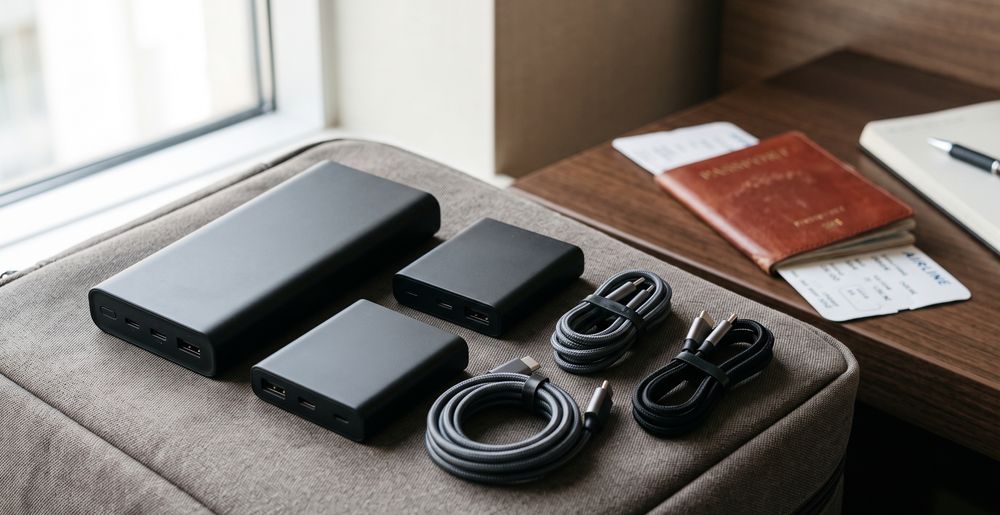
Best Portable Power Bank for Travel and Emergencies

About the author...
Dave has been taking gadgets apart since he was old enough to be told not to. Every pick here is checked against the manufacturer's own documentation rather than the retail listing, and each star rating starts from a product's real Amazon customer score before being adjusted for performance, build quality, features and value. Read more about how ratings are calculated.
The best portable power bank right now is the Anker Prime 20,000mAh Power Bank, thanks to its verified 200W output and real-time charge display. See how five other well-reviewed alternatives compare below, depending on what you actually need to charge.
A power bank is a self-contained rechargeable battery, roughly the size of a phone or a slim paperback. It stores charge and hands it back through USB ports when there's no wall socket nearby. It's the standard fix for a phone dying mid-shift, a flight with no seatback power, or a weekend where the nearest outlet is a long walk away. Capacity ranges from pocket-sized 5,000mAh units good for one phone top-up, to 20,000mAh-plus bricks that can also feed a laptop.
Don't confuse a power bank with a portable power station or solar generator. Those are much larger units with a built-in AC wall outlet, designed to run appliances, and they belong in a different weight class entirely. If that's what you actually need, see our guide to portable power stations instead. Everything below is a USB and USB-C pack sized for phones, tablets, earbuds and similar small electronics.
What separates a good power bank from a mediocre one isn't the number printed on the case. It's whether the stated wattage holds up under real load. It's whether the ports deliver what the spec sheet promises rather than throttling under a warm palm. And it's whether the brand behind it stands by the product with a real warranty.
Key Takeaways (TL;DR)
- Usable capacity is roughly 60-70% of the rated mAh figure once voltage step-up losses are factored in, so a 20,000mAh bank behaves more like 12,000-14,000mAh from your phone's side.1
- Watt-hours (Wh), not mAh, is what airlines actually regulate. Most phone-sized power banks sit comfortably under the unrestricted 100Wh carry-on limit.2
- USB-C PD wattage decides real charge speed more than capacity does. 100W+ models can top up a laptop; 15-45W models can't.3
- Pass-through charging lets you recharge the bank and power a device at the same time, but not every model handles it cleanly.
- Magnetic wireless charging is convenient but slower than a cable, so treat it as a top-up feature rather than your primary charge method.
- Cycle life for a typical lithium-ion cell is around 300-500 full charges before capacity noticeably fades.4
- Pack your own USB-C cable too. Not every power bank in this price range includes one long enough for how you'll actually use it.
How We Choose
We prioritized capacity that holds up in the real world and USB-C Power Delivery output verified against the manufacturer's own spec sheet, not the Amazon listing. We also weighed build signals like port durability and warranty length. Distinctive features such as laptop-class wattage, magnetic wireless charging, and IP-rated housings only counted in a product's favor once we could confirm the manufacturer's claim independently.
Quick Comparison
Each product's overall rating starts from its real Amazon customer rating. It then gets adjusted, by up to ±0.5, for real-world performance, build quality, features, and value. Click a product name to jump straight to its full review below.
| Product | Best For | Type | Key Detail | Key Spec |
|---|---|---|---|---|
|
Anker Prime Power Bank (20,000mAh, 200W) 4.6 |
Buyers who want laptop-grade charging speed | Power bank | 200W output | 72Wh, USB-C PD 3.0, 200W total output |
|
Belkin BoostCharge Power Bank 20K 4.5 |
A simple, reliable everyday power bank | Power bank | 20,000mAh, 15W | USB-C in/out, 2x USB-A |
|
INIU Smallest 20,000mAh Power Bank 4.8 |
Travelers who want big capacity for less | Power bank | 20,000mAh compact | PD + QC fast charging, LED display |
|
UGREEN Nexode 100W Power Bank 4.9 |
Anyone who needs to charge a laptop and phone | Power bank | 100W USB-C PD | 100W USB-C PD, pass-through charging |
|
Baseus EnerFill Magnetic Power Bank 4.5 |
Snap-on charging without fumbling a cable | Magnetic power bank | 22.5W magnetic | MagSafe-compatible, LED indicator |
|
ELECOM NESTOUT Rugged Power Bank 4.7 |
Hikers, campers and anyone near water or dust | Rugged power bank | IP67, 32W | IP67, MIL-spec shock resistance |
Anker Prime Power Bank (20,000mAh, 200W)
Best Overall Power Bank
based on 4025 Amazon reviews (4.3★), adjusted for performance, build and value
What We Love About the 200W Flagship
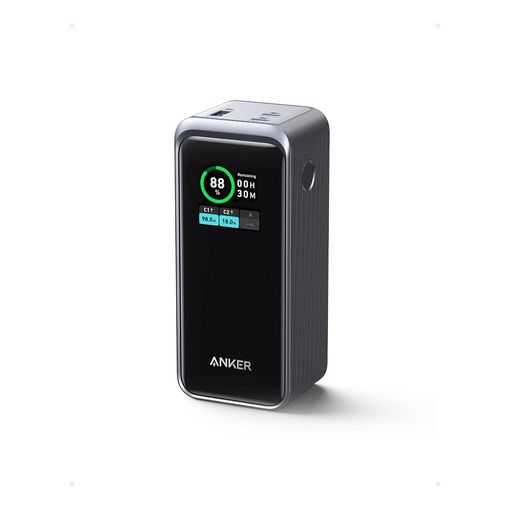
Anker's flagship power bank treats a laptop as just another device to charge, not a special case. Its two USB-C ports and one USB-A port share a genuine 200W total output. Anker states it can take a 16-inch MacBook Pro from empty to 50% in around 40 minutes.5 An independent teardown-style review measured around 60Wh of real, retrievable capacity against the 72Wh rating, a roughly 83% real-world yield that's still well ahead of the 60-70% typical of this category.6 The colour display on the front shows a countdown to full charge and the exact wattage each port is drawing, so you're not guessing whether a cable is fast-charging or just trickling.
What holds it back from a perfect score is price and bulk. At 72Wh it's still safely under the airline carry-on threshold, but it's the heaviest and most expensive bank in this lineup, and most people charging just a phone will never touch that 200W ceiling.
200W Flagship: All The Details
The Prime pairs a 20,000mAh cell, rated at 72Wh, with USB PD 3.0, the fast-charging standard that covers the 200W total output across its three ports.5 In the box you get a 0.6m USB-C cable and a travel pouch, and Anker backs the unit with its standard hassle-free warranty and lifetime customer support.5 Three simultaneous charging modes let it split power intelligently across one, two, or three connected devices, rather than forcing an even split regardless of what's plugged in.
Belkin BoostCharge Power Bank 20K
Best Everyday Power Bank
based on 5491 Amazon reviews (4.4★), adjusted for performance, build and value
What We Love About the No-Fuss Everyday Pick
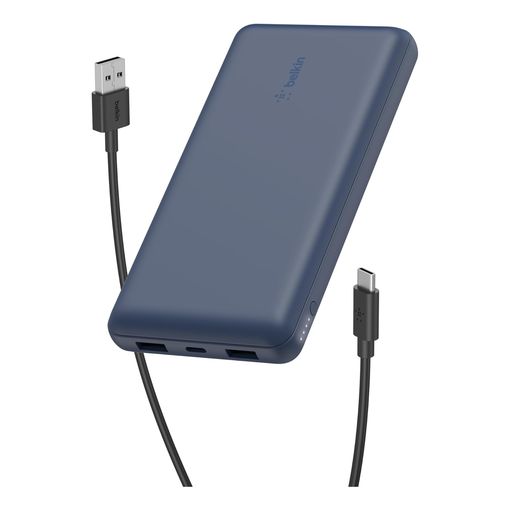
Belkin's BoostCharge 20K is refreshingly unglamorous: no wireless coil, no smart display, just a big battery with three ports that Belkin backs with an international two-year warranty.7 Belkin's own support documentation confirms it can run three devices at once from its USB-C and USB-A ports. That covers most people's actual daily bag: a phone, a tablet, and a set of earbuds.7 It's the pick for someone who wants that covered without reading a manual first.
The tradeoff is speed. Total output tops out at 15W across all ports, with no USB-C Power Delivery support.7 A modern phone that can pull 25W or more from a proper PD charger will charge noticeably slower here than on several other banks in this list. If overnight or all-day trickle charging suits your routine, that ceiling won't matter much. If you want your phone back at 80% during a coffee break, look further down this list.
The Everyday Pick: All The Details
Capacity is 20,000mAh, delivered through one USB-C and two USB-A ports, with a USB-C to USB-A cable included in the box. There's no digital screen, just a row of LED dots that estimate remaining charge, and the housing feels solid without any of the extras that add cost elsewhere in this roundup. Belkin's warranty runs two years internationally,7 longer than several rivals here, which matters given how often a power bank ends up living in a bag getting knocked around.
INIU Smallest 20,000mAh Power Bank
Best Budget Power Bank
based on 27135 Amazon reviews (4.6★), adjusted for performance, build and value
What We Love About the Budget Pick
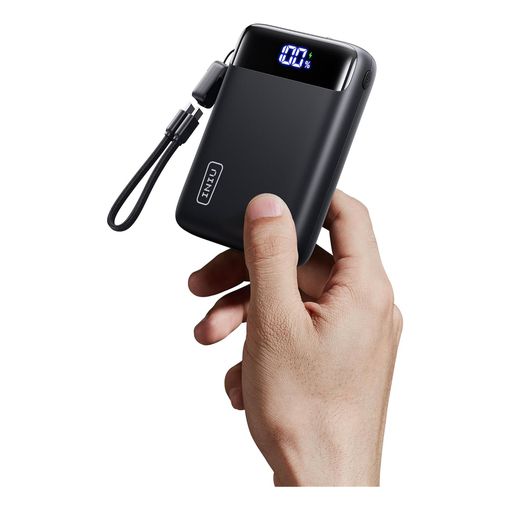
INIU's pitch here is capacity density. The same 20,000mAh most rivals pack into a brick gets squeezed into a smaller shell, using a layout INIU calls HyperStack architecture; the company claims it's 20 to 30% smaller than a conventional design.8 It's also the most reviewed product in this entire roundup by a wide margin, with well over 20,000 Amazon ratings averaging 4.6 stars. That's a genuinely large sample to judge reliability against. INIU backs it with a three-year warranty, longer than most competitors here.9
At 22.5W combined output it won't touch a laptop, and its ports share bandwidth rather than each hitting full speed at once, so treat this as a phone-and-earbuds bank rather than an everything bank. Build quality feels appropriately budget: solid enough for daily use, but without the reinforced housing or premium finish of the pricier picks in this list.
The Budget Pick: All The Details
A built-in LED percentage display is a genuinely useful touch at this price point, and a short braided USB-C cable is tucked into the case so you're rarely caught without one. Output is rated at 22.5W across PD and Quick Charge protocols,8 enough to get a phone to roughly 75% in about 25 minutes on INIU's own figures. Ports run USB-C out, USB-C in for recharging, and a secondary USB-A output for a second device, with the whole unit sized to slip into a jacket pocket rather than needing a dedicated bag compartment.
UGREEN Nexode 100W Power Bank
Best Power Bank for Laptops
based on 5370 Amazon reviews (4.5★), adjusted for performance, build and value
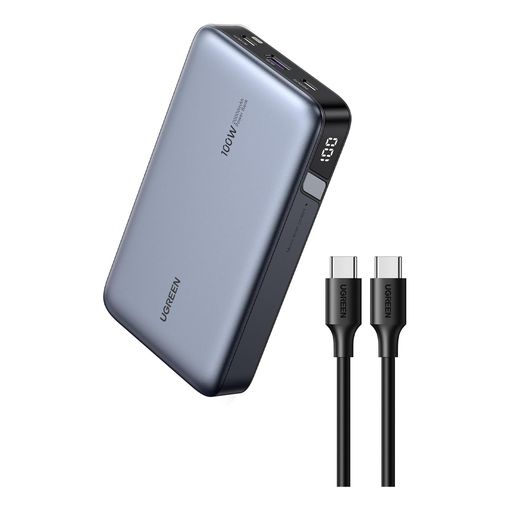
What We Love About the Laptop Charger
UGREEN built the Nexode 100W around one job: keeping a laptop alive without a wall charger. Its primary USB-C port pushes the full 100W on its own, or splits down to 65W when a second device is plugged in. UGREEN's own figures put a 16-inch MacBook Pro at 42% charge after 30 minutes.10 That's genuinely useful output rather than a marketing figure that collapses under a real load. It also supports pass-through charging, recharging itself from empty in around 1.6 hours at 65W while still feeding power out to whatever's plugged in.10 Neither the Belkin nor the INIU picks in this list can match that.
At 20,000mAh it isn't the biggest bank here, so heavy laptop users should expect roughly one full charge for a demanding machine rather than two or three. The digital display readout is small but legible, showing remaining percentage at a glance.
Laptop Charger: All The Details
Three ports cover most combinations: a 100W USB-C, a second 30W USB-C, and a 22.5W USB-A. A laptop, a phone, and a pair of earbuds can all draw power at once, with total output capped at 100W when it's split across ports.10 UGREEN backs the Nexode with a two-year warranty and includes a rated 100W USB-C to USB-C cable in the box.10 That matters, because pairing a laptop-class power bank with a cheap cable bottlenecks it at a fraction of its rated speed.
Baseus EnerFill Magnetic Power Bank
Best Magnetic Wireless Power Bank
based on 2299 Amazon reviews (4.4★), adjusted for performance, build and value
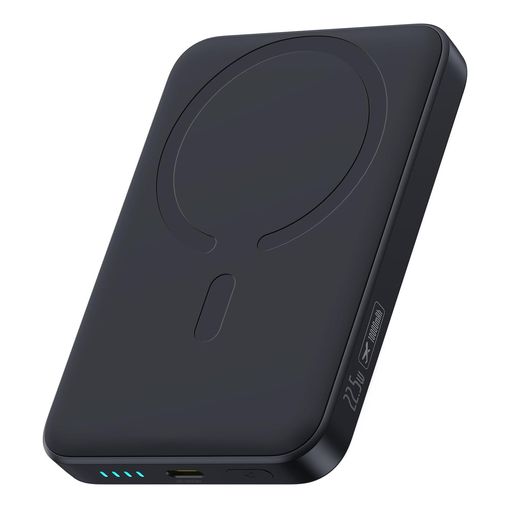
What We Love About the Snap-On Charger
Baseus's EnerFill drops the cable entirely for compatible phones. The magnetic ring on the back aligns itself and holds in place, then delivers up to 22.5W wirelessly.11 For anyone who has fumbled a charging cable in a dark car or on a train table, that convenience is real, and the four-LED battery gauge on the edge means you can check remaining charge without picking up your phone. A built-in USB-C port also lets it charge a second device by cable at the same time.
Wireless charging is inherently less efficient than a cable, though, and 10,000mAh is the smallest capacity in this roundup: good for roughly one and a half phone charges rather than several. Baseus markets this model as MagSafe-compatible rather than under a formal Qi2 certification, so that's how we're describing it here too, without overstating a standard it hasn't been tested against.
Snap-On Charger: All The Details
The airline icon printed on the case reflects that its 10,000mAh capacity, in the roughly 35-37Wh range once converted, sits well inside the unrestricted carry-on tier.2 Baseus's current policy covers products bought from 2024 onward with an 18 to 24-month warranty depending on region.12 The unit ships with a USB-C cable and includes overcharge and short-circuit protection, and the flat, rounded shape is designed to sit flush against a phone rather than adding noticeable bulk in a pocket.
ELECOM NESTOUT Rugged Power Bank
Best Rugged Power Bank
based on 1826 Amazon reviews (4.5★), adjusted for performance, build and value
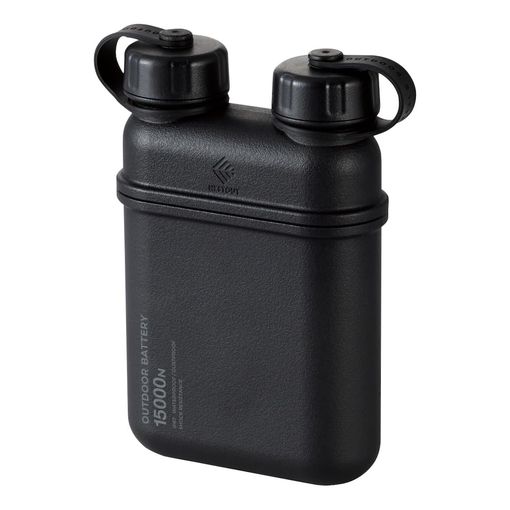
What We Love About the Outdoor Pick
NESTOUT looks like nothing else in this roundup, and that's deliberate. ELECOM shaped it after a vintage fuel canister, with two screw-down rubber caps sealing the ports against water and dust to an IP67 rating.13 That means it can handle a splash, a dusty trail, or being dropped in a bag with wet gear, situations that would put any of the other five banks here at real risk. ELECOM also rates the shell to withstand drops and rough handling under military-standard shock testing.13 The design also won an iF Design Gold Award, which at least confirms the build wasn't an afterthought bolted onto a standard cell.
Charging speed and capacity are the tradeoffs. At 15,000mAh and 32W,13 it's mid-pack for capacity and won't fast-charge a laptop, and a full recharge takes around three and a half hours.13 If your trips don't involve water, dust, or drops, you're paying for ruggedness you'll never actually use.
Outdoor Pick: All The Details
Output runs through a USB-C port rated at up to 32W alongside supporting USB-A connections, backed by a five-level LED indicator and a 1/4-inch tripod screw mount on the base, a genuinely practical touch for campers who also run a headlamp or small light off it. Battery capacity is specified directly by ELECOM at 3.6V/15,000mAh,13 and built-in protections cover overcharge, overdischarge, overvoltage, overcurrent, short circuit, and temperature faults.13
Best Portable Power Bank FAQ
What should I look for when buying a power bank? Match the wattage to what you're actually charging, not just the mAh number on the box. Someone charging only a phone is fine with 20-30W and 10,000-20,000mAh. Anyone charging a laptop needs at least 65W of USB-C PD, ideally 100W, and should check pass-through support if they want to leave the bank plugged in overnight.
Why doesn't my phone get the full rated mAh from a power bank? Because the mAh figure on the box is measured at the battery cell's native 3.6-3.7V, but the power bank steps that voltage up to 5V, 9V, or higher to actually charge your device, and that conversion isn't lossless. In practice, a phone typically receives somewhere around 60-70% of the rated mAh once voltage conversion and circuit losses are accounted for,1 so a 20,000mAh bank behaves more like a 12,000-14,000mAh one from your phone's perspective.
Can I bring a power bank on a plane? Most aviation authorities follow a similar general framework. Power banks up to 100 watt-hours (Wh) are generally allowed in carry-on baggage without restriction. Batteries between 100Wh and 160Wh usually need airline approval, and anything above 160Wh is typically not permitted on passenger aircraft.2 To estimate your bank's Wh rating, multiply its rated mAh by its nominal voltage, usually 3.6-3.7V, and divide by 1,000. A 20,000mAh bank comes out around 72-74Wh, comfortably inside the unrestricted tier. Exact rules vary by airline and country, so check with your specific carrier before flying, and never pack a power bank in checked luggage.
What's the difference between USB-C PD and Quick Charge? USB Power Delivery (PD) is the USB-C fast-charging standard. PD 3.0 tops out at 100W, while the newer PD 3.1 standard extends that ceiling to 240W for laptop-class charging.3 Quick Charge is Qualcomm's older, separate fast-charging protocol, mostly relevant to Android phones with Qualcomm chipsets. Several power banks, including two in this roundup, support both so they can fast-charge whichever device you plug in.
What is pass-through charging, and do I need it? It's the ability to recharge the power bank from the wall while it simultaneously charges a connected device. That's useful if you want everything topped up overnight on a single plug rather than juggling two chargers. Not every bank handles it cleanly, though. Some generate more heat or wear the battery faster under sustained pass-through use, so check the manufacturer's own guidance rather than assuming it's fine for all-night use on every model.
Does magnetic wireless charging work as well as a cable? No, not in raw speed or efficiency. Wired USB-C charging loses less energy in conversion and typically delivers more watts than a magnetic wireless connection, so treat magnetic charging as a convenience feature for topping up rather than your fastest option when you're in a hurry.
How long do power banks actually last? Most lithium-ion cells used in consumer power banks are rated for somewhere around 300 to 500 full charge cycles before capacity fades to about 80% of original,4 after which the bank still works but holds noticeably less charge. Storing a bank fully drained, or leaving it at 100% for long periods, accelerates that decline, and so does heat. Partial charging and cool, dry storage get you closer to the upper end of that range.
Are power banks safe, and what about recalls? Yes, when used and stored properly. Lithium-ion cells aren't entirely risk-free, though, and recalls do happen industry-wide when a specific model or batch has a cell fault. Register any power bank with the manufacturer when you buy it. Stop using it immediately if it swells, gets hot while idle, or smells unusual, and periodically check your national product-safety regulator's recall list, since most countries run one. None of the six specific models recommended in this guide were subject to an active recall at the time of publication, but that status can change, so it's worth a quick check before you buy.
The Best Portable Power Bank for You
If you need one bank that covers everything from a phone top-up to a genuine laptop charge, the Anker Prime earns its place at the top through verified 200W output and a display that actually tells you what's happening. Most people charging just phones and earbuds will be better served by the Belkin or INIU picks, which cost less and do the everyday job perfectly well. If your priority is laptop-capable charging, cable-free convenience, or a housing that can survive a hike, the UGREEN, Baseus, and ELECOM picks each solve that specific problem better than a generalist bank would.
-
Why is the Rated Capacity of Power Banks Lower Than Expected - Anker ↩︎ ↩︎
-
BU-808: How to Prolong Lithium-based Batteries - Battery University ↩︎ ↩︎
-
Getting to know the Belkin BOOST↑CHARGE Power Bank 20K, BPB012 - Belkin ↩︎ ↩︎ ↩︎ ↩︎
-
Baseus EnerFill FM11 Magnetic Power Bank 10000mAh 22.5W - Baseus ↩︎
-
NESTOUT Outdoor Portable Battery 15000mAh - ELECOM ↩︎ ↩︎ ↩︎ ↩︎ ↩︎ ↩︎